Service area · Lemont, IL
Truck repair for Lemont, IL tankers, aggregate and local carriers, across the valley in Romeoville
From Lemont to the shop
about 15–25 minutes off-peak · about 9–14 miles, depending on route · Romeo Rd (135th St) west across the Des Plaines valley to Weber Rd and Anderson Dr, or I-355 north from 127th St to I-55 south and the Weber Rd exit
565 Anderson Dr Unit B, Romeoville, IL 60446
- Monday - Friday: 7:00 AM - 5:00 PM
- Saturday: 7:00 AM - 12:00 PM
- Sunday: Closed
What Lemont fleets bring to Romeoville most
The services this town's duty cycle asks for, each with its own page.
Truck and trailer repairs and alignments
Frame, crossmember, landing gear, coupling and axle alignment work on tractors and trailers.
Suspension and air brake repair
Air ride, leaf springs, bushings and air brakes on tractors and trailers.
DOT inspections for trucks and trailers
Annual FMCSA inspections for tractors and trailers, with findings quoted before any repair.
Transmission and differential repair
Clutch, manual, AMT and automatic transmission repair; differential, power divider and final drive rebuilds.
DPF cleaning and replacement
Off-truck cleaning, flow testing, forced regens and replacement when the filter is past cleaning.
Is it faster from Lemont to Truck Clinic on I-355 or on Romeo Rd?
It depends on which side of Lemont the truck starts from; the three usual routes land within a few minutes of each other off-peak, and none of them is a long trip. A driver who drops a unit in the morning is back on Archer Ave well before lunch, and the written quote follows once we have looked at the truck.
| Where the truck starts | Route to 565 Anderson Dr Unit B | Off-peak time (approximate) |
|---|---|---|
| Downtown Lemont, Archer Ave, the canal terminals | Romeo Rd (135th St) west across the Des Plaines valley, then Weber Rd to Anderson Dr | about 15–20 minutes |
| The 127th St side and the Homer Glen edge | I-355 north to I-55 south, off at the Weber Rd exit, then Anderson Dr | about 20–25 minutes |
| North of the river on Lemont Rd (Woodridge, Darien, Argonne) | Lemont Rd to I-55 south, off at the Weber Rd exit | about 15–25 minutes |
Romeo Rd is the shorter run from the valley floor; with a loaded tanker or a tri-axle dump in bad weather, I-355 is the easier drive. Add time for the Weber Rd lights in the afternoon. Call (815) 887-0212 before you leave with the unit number, the engine model and what the driver noticed, and we will say whether a bay is open that day. If the truck will not make the trip under its own power, it goes on a tow: Truck Clinic does not come to the truck.
Which repairs does a Lemont tanker or aggregate fleet need most often, and why?
Four jobs cover most of what a Lemont duty cycle produces, and each one has a reason that is specific to how the town's trucks are used.
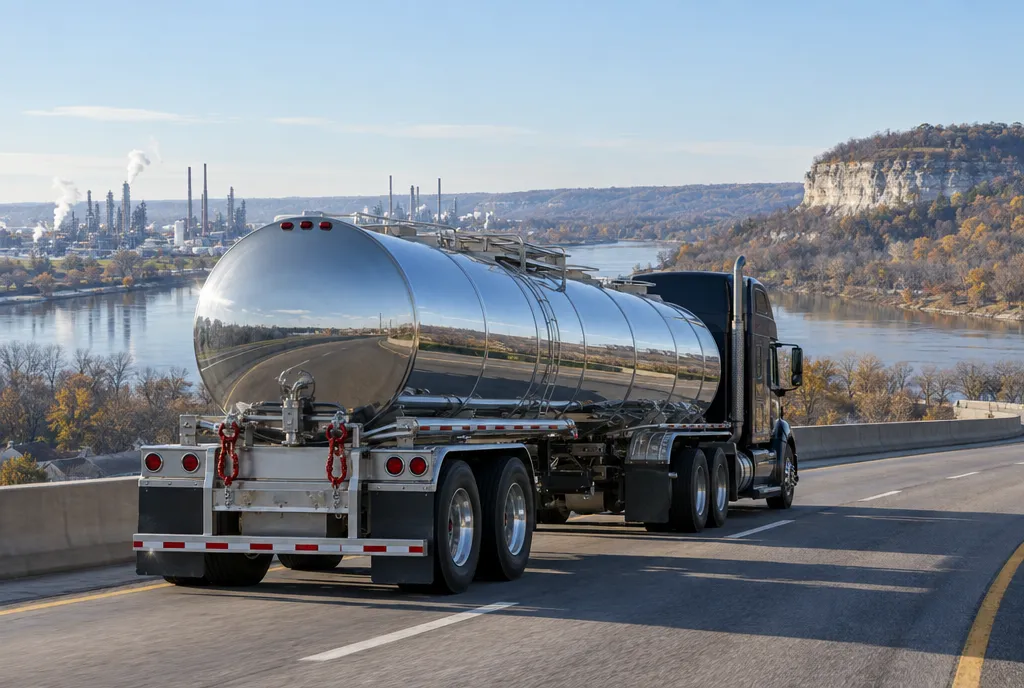
- Tank-trailer running gear and brakes. A tanker gets hooked and dropped more than a van, and it spends its life at the rack, the scale and the terminal gate. Hub seals weep, slack adjusters stop adjusting, gladhand seals and air lines leak, and the trailer ABS lamp stays on. That is truck and trailer repair and suspension and air brake work on the trailer under the tank, which is separate from the tank itself (more on that below).
- Driveline and differential on aggregate and terminal haul. Loaded one way, empty the other, with a full-weight takeoff from a stop every few minutes. Power dividers, pinion bearings and U-joints wear first, and a howl that follows road speed is the usual first complaint. That goes to transmission and differential repair.
- DPF cleaning on short-loop units. A quarry-to-plant loop or a terminal shuttle rarely holds exhaust temperature long enough to finish a regen. Soot load climbs, the lamp comes on, and the derate follows. DPF cleaning off the truck resets that; the duty cycle is why it comes back, so the interval gets set per unit rather than by the sticker.
- Annual inspections on both units. Under 49 CFR 396.17 each vehicle in a combination needs its own periodic inspection at least once in the preceding 12 months, so a tanker tractor and its trailer are two DOT inspections and two reports. Fleets batch them by sticker month.
Lights and wiring come in behind those four: a corroded seven-way plug on a trailer that sits outside at the terminal all winter is electrical repair, not a bulb.
What does the refinery-and-quarry duty cycle around Lemont do to a tractor?
The Lemont duty cycle is heavy, short and hilly, and each of those three things wears a different part of the truck.
- Heavy and short. A loaded stone or liquid haul rarely gets to cruise. Every cycle is a full-weight takeoff, a short run, a dump or a drop and an empty return, which means more clutch engagements per mile than a line-haul tractor sees in a week. The symptoms are a clutch that engages high, a chatter on takeoff, a power divider that chatters on tight corners at the plant, and a pinion seal that starts to weep.
- Hilly. Lemont sits in the valley, and the grades up out of it on State St, Lemont Rd and 135th St are short but steep enough that a loaded descent puts heat into the drums. Glazed linings, heat-checked drums and a trailer that pulls to one side on a hard stop show up first on the units that run those grades every day. The air brake leak test and stroke check belongs in the yard routine.
- Hooked and dropped. Tank trailers and quarry pups get swapped constantly. Fifth-wheel jaws wear, kingpins develop play, the upper coupler on an older trailer cracks at the weld, and gladhand seals get crushed. Coupling and upper-coupler defects are inspection items, so they get caught at the scale if the fleet does not catch them first.
- Dust, brine and stop-and-go. Quarry dust finds the air dryer and the wheel seals; winter brine from 127th St and Archer Ave eats trailer wiring and ABS connectors; idle time at the rack and at the lights keeps the DPF cold and the batteries undercharged.
None of that is unusual for the duty cycle, and all of it is easier to catch early than to rebuild later. A differential that comes in for the howl is usually a bearing, seal and setup job; one that comes in on a hook after the carrier lets go is a carrier, and the truck waits on parts.
What will Truck Clinic do on a tank trailer from Lemont, and what will it not do?
Everything under and behind the tank is work we do; the tank itself is not. Here is the line, plainly, so nobody drives over from Lemont expecting a test we cannot give them.
| On a tank trailer | At Truck Clinic |
|---|---|
| Axles, hubs, wheel bearings, seals, wheels and tires | Yes |
| Brake chambers, slack adjusters, drums, linings, ABS, air lines and gladhands | Yes |
| Lights, wiring, the seven-way plug, reflective tape | Yes |
| Air-ride and spring suspension, hangers, torque arms, ride-height valves | Yes |
| Kingpin, upper coupler, landing gear, rear impact guard | Yes |
| The periodic inspection on the trailer's Appendix A items (brakes, coupling, lights, suspension, frame, tires, wheels) | Yes |
| External visual, internal visual, lining, pressure, leakage and thickness tests on the cargo tank | No |
| Any repair to the tank shell or its fittings that would need one of those tests afterward | No |
The cargo-tank tests under 49 CFR 180.407 run on their own schedule by test type and tank specification, a tank whose test has come due may not be filled and offered for transportation until it passes, and the tests have to be done by a qualified cargo-tank inspector who marks the tank afterward. Truck Clinic does not perform them and does not sign off on them. What we do is keep the trailer under the tank safe and legal between those tests: the brakes, the running gear, the lights, the suspension and the coupling, plus the annual inspection on those items. In practice a Lemont tanker carries two clocks, the tank tests and the trailer's annual, and the fleet keeps both files. Bring the trailer in on the annual's schedule, tell us the tank's test dates so we are not working around a trailer that is about to go to the tank shop, and we will hand back a report and a written quote for anything that failed. Nothing is opened or ordered until you approve it.
Is Truck Clinic as short a run from Woodridge, Darien and Homer Glen as it is from Lemont?
About the same, by the same three routes, and the drill on arrival is identical.
- Woodridge and Darien come down Lemont Rd to I-55 and south to the Weber Rd exit, the same stretch of I-55 the Bolingbrook distribution fleets use from the north.
- Homer Glen comes up 143rd St or 159th St to I-355, then north to I-55; the Lockport page covers the Romeo Rd alternative from the south side of the valley.
- Romeoville fleets are already on Weber Rd; the Romeoville page covers how to find the door and what to do on arrival.
Whoever is driving, call (815) 887-0212 or send the unit details through the contact page before the truck leaves, tell us the engine model, any codes and what the driver noticed, and we will say whether a bay is open. Hours are Mon–Fri 7:00 AM–5:00 PM and Sat 7:00 AM–12:00 PM at 565 Anderson Dr Unit B, Romeoville, IL 60446. Trailers can come in without the tractor. Small repairs with parts on the shelf can be same-day when a bay is open; anything larger comes back to you as a written quote first.
One shop, in Romeoville
Truck Clinic is shop-based: there is no roadside or mobile service, so the truck comes to 565 Anderson Dr Unit B, Romeoville, IL 60446. Call first and we'll say whether it should be driven over or towed.
The Romeoville shop: access, hours and what to bring →Questions
Questions from Lemont fleets
Do you work on the running gear of tank trailers from Lemont?
Yes. Axles, hubs, bearings and seals, brakes and the air system, lights and wiring, suspension, kingpin and upper coupler, landing gear and tires are all repaired in the Romeoville shop, and the trailer can come in without the tractor. The tank itself is not tested or repaired here; those tests stay with your cargo-tank inspector. See Truck and trailer repair.
Can you do the DOT annual inspection on a tanker tractor and trailer?
Yes, as two inspections with two reports, because the federal periodic inspection applies to each vehicle in a combination. The trailer's inspection covers the brakes, coupling, lights, suspension, frame, tires and wheels under the tank; it does not include the cargo-tank pressure, leakage or visual tests, which run on their own schedule with a qualified tank inspector. Anything that fails comes back as a written quote before any repair. See DOT inspections.
How do I get from Archer Ave in Lemont to Truck Clinic?
Take Romeo Rd (135th St) west across the Des Plaines valley into Romeoville, then Weber Rd to Anderson Dr; the shop is at 565 Anderson Dr Unit B, about 15–20 minutes off-peak. With a loaded tanker, I-355 north to I-55 south and the Weber Rd exit is the easier run at about 20–25 minutes off-peak. Hours are Monday - Friday: 7:00 AM - 5:00 PM; Saturday: 7:00 AM - 12:00 PM; Sunday: Closed; call (815) 887-0212 when you pull in and we will say where to stage the truck.
Does Truck Clinic come out to a truck that quits on I-355 near Lemont?
No. Truck Clinic does not offer roadside service, mobile repair or pickup. If a unit will not make the trip under its own power, have it towed to 565 Anderson Dr Unit B and call (815) 887-0212 so a bay can be ready. Before you decide, tell us the symptom: a slow whine or a small seal weep can usually be driven in; a hot differential, a knock that grows with load or a transmission that will not hold a gear should not.
Do you work on the dump trucks and mixers that run the Lemont quarries?
Yes. Brakes, suspension, frame and crossmember cracks, driveline and differential noise and DPF faults on short loops are the usual jobs on quarry trucks, and all of them are done in the same bays as the tractor-trailer work. Have the engine model and any codes ready when you call, and say whether the complaint shows up loaded or empty and whether it changes with speed or with load. See Suspension and air brakes.
Nearby service areas
The same shop, from the next town over.
Further reading
From the shop's own guides.
Quote first, then the work.
Tell us what the truck is doing.
A no-start, a derate counting down, a brake out of adjustment the week before an inspection, or a fleet that needs a maintenance schedule someone actually follows — send the fault code and the engine, or call (815) 887-0212, and you get a straight answer: bay today, part first, or tow. The diagnosis and the price come to you in writing, and nothing is opened up until you approve it.
(815) 887-0212Monday - Friday: 7:00 AM - 5:00 PM
Saturday: 7:00 AM - 12:00 PM
Sunday: Closed
Shop-based only — we don't run roadside or mobile service, so the truck comes to Romeoville. Same-day whenever a bay is open.
Need your truck fixed ASAP?
Don’t let downtime hold up your next load. Leave your number and tell us what you need—we’ll call to discuss the next available service time.