
Truck repair · Romeoville, IL
Semi truck brake repair in Romeoville, IL
Air brake repair for tractors and trailers in Romeoville: shoes, drums, slack adjusters, chambers and a written quote first.
5.0 from 203 Google reviewsWritten quote before work65+ person team
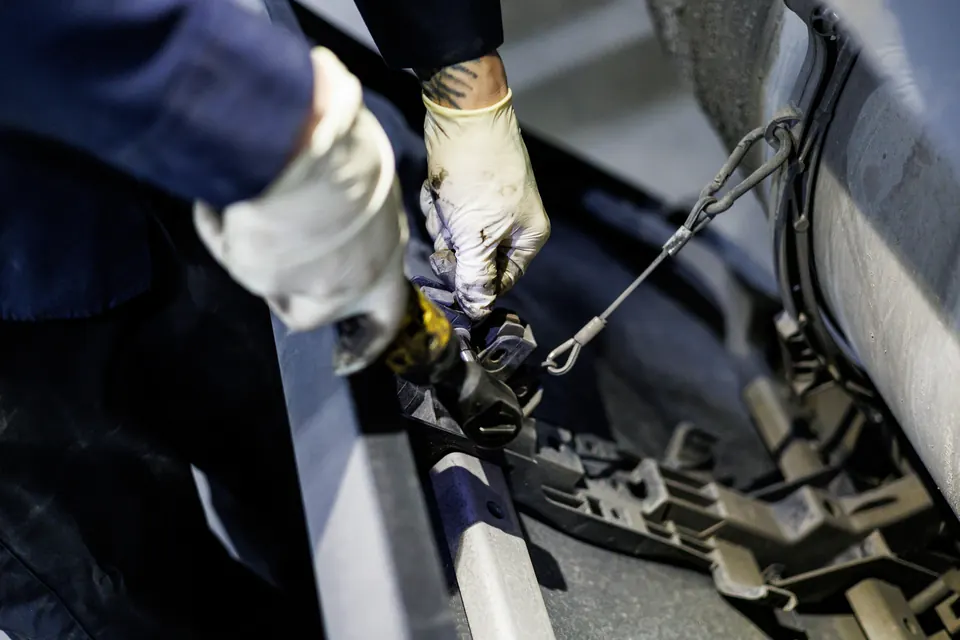
If you searched truck brake repair near me, the bay is Truck Clinic Corp. at 565 Anderson Dr Unit B, truck repair in Romeoville, IL, just off I-55.
The full service description
Semi truck brake repair here covers the foundation brakes and the air system on tractors and trailers. Every job starts with a written quote you approve before a part is ordered. The shop is shop-based, with no roadside assistance, no mobile service and no pickup, so the unit comes to Anderson Drive.
What's included
- Shoes, drums, S-cams, bushings and return springs
- Air disc pads and rotors
- Slack adjusters and pushrod stroke at every chamber
- Chambers, valves, gladhands and air lines
- Compressor, dryer, governor and the applied leakdown test
- ABS sensor and modulator faults read in the diagnostics bay
What does semi truck brake repair cover on a tractor and a trailer?
Air brake repair at Truck Clinic is the wheel-end and the air that feeds it, on the tractor and on the trailer. The same list is what the suspension bay already hands to this page when the complaint is the brakes rather than the ride:
Read the full section
- Foundation brakes. Shoes and drums, S-cams and bushings, return springs, air disc pads and rotors.
- Adjustment. Slack adjusters that have stopped adjusting, and pushrod stroke measured against 49 CFR 393.47.
- Air supply. Compressor output, dryer cartridge, governor settings and the applied leakdown test.
- Chambers and valves. Diaphragms, gladhands, the service line and a relay valve that leaks only when the pedal is down.
- ABS. A wheel speed sensor or modulator fault, read from the controller in the diagnostics bay.
A trailer can be dropped without the tractor, and the tractor goes back to work. That drop, and the lights and landing gear that often come with it, stays on the trailer repair page. Springs, hangers, torque rods and ride height stay on suspension repair. The quote lists the brake work and the suspension work separately, and nothing is opened until you approve it.
What does a pull, a hissing chamber, or slow air build-up usually mean?
The complaint is rarely the part name. It is what the driver felt, and those complaints already have a check behind them in the bay.
Read the full section
| What you notice | What gets checked |
|---|---|
| A pull under braking, a drag, or one hot drum | Linings, the drum, a slack adjuster that has seized, a chamber that is not releasing |
| A chamber hissing at the wheel end | The diaphragm, the hose and the fitting at that wheel |
| Slow air build-up, or a low-air warning on a cold morning | Compressor output, governor cut-in and cut-out, the dryer cartridge, and the applied leakdown |
| Air that will not hold overnight, or gladhands that hiss when coupled | A cracked gladhand seal, a service line that never seated, a relay valve |
| A slack adjuster you had to set by hand | Cam bushings, clevis pins and the adjuster that stopped doing its job |
| An ABS lamp that stays on | The wheel speed sensor and the modulator, read in diagnostics |
An automatic slack adjuster stops adjusting once the hardware around it wears. The shop measures every chamber on a full application and fixes the cause instead of manually adjusting an automatic slack. Stroke is marked and measured. It is not judged by how the pedal feels.
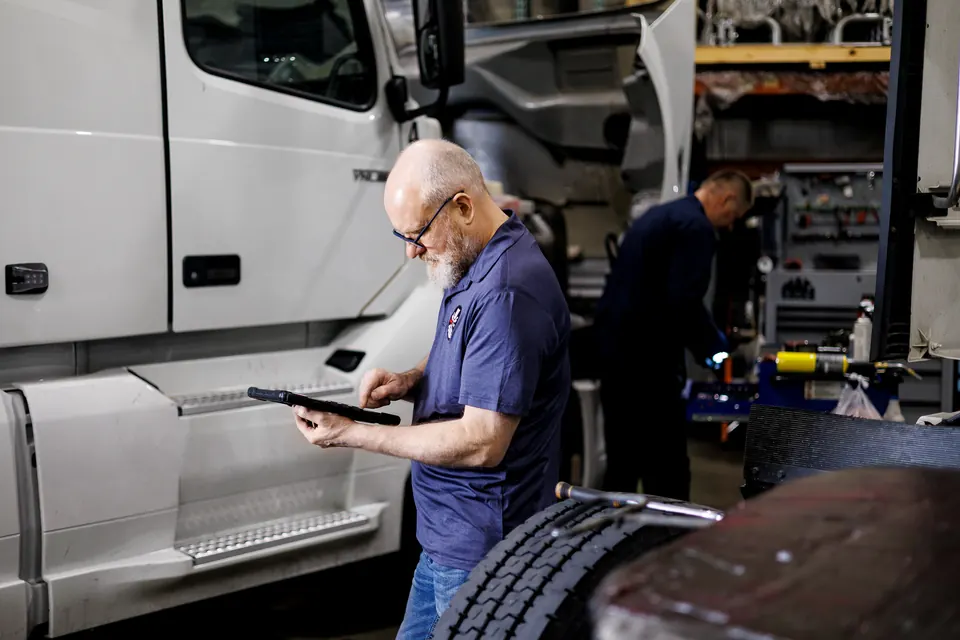
How are stroke and leakdown measured before shoes or drums are ordered?
The cheap part of a brake repair is the measurement. The expensive part is a full reline on a wheel-end whose adjuster or chamber was the real fault. The order in the bay:
Read the full section
- The unit, empty when it can be. A loaded trailer cannot be lifted, and a measurement you cannot reach is a guess. Bring it empty where possible.
- Pushrod stroke at every chamber on a full application, against the chamber type in 49 CFR 393.47. One wheel-end past the limit is the usual find, and it is usually an automatic slack adjuster that has stopped adjusting.
- The hardware at that wheel. Shoes, drums, S-cams, cam bushings, clevis pins, return springs and the chamber, checked together because the adjuster quits once the parts around it wear.
- Air, engine off. A drop with nothing applied, and a drop with the service brakes applied. Build time, governor cut-in and cut-out, and the dryer cartridge sit in the same pass. The timed leakdown is the same test described in the air system leak diagnosis guide.
- Which unit owns the leak. When the tractor came with the trailer, disconnecting them tells you which side the air is leaving. Gladhand seals, the service line and the relay valve are the usual trailer-side finds.
The written quote then lists what failed and what is worn but still serviceable. Replacing one side of shoes when the other side is the same age usually books a second visit, and the quote says so before anything is ordered. A DOT inspection uses the same stroke and leakdown measurements. When the sticker is due, the inspection and the repair can be the same visit, and the report is finished after the repair you approve.
When does an ABS fault on the brakes go to the diagnostics bay?
An ABS lamp is not a shoe measurement. The controller keeps its own faults, and a chassis-side code often explains a lamp the driver has been clearing.
Read the full section
- Wheel speed sensor and modulator faults are read from the ABS controller in the diagnostics bay, the same full-module scan that covers engine, transmission, body and aftertreatment.
- A lamp that stays on behind one tractor and not another is often the cord or the plug, which is an electrical repair, not a reline. The brake page does not guess at that.
- A sensor fault and a long stroke on the same wheel are two findings. Both go on the quote. The shoe does not get blamed for a modulator, and the modulator does not get blamed for a lining that is gone.
The scan is the first step when the lamp is the complaint. The wheel-end measurement still happens, because a lamp and a stroke past the limit can be on the truck at the same time. Fleet maintenance already measures stroke and runs a leakdown at every PM, which is where most of these show up before the lamp or the scale does.
What moves the quote and the day on an air brake repair?
No dollar figure, because it would be wrong for your truck. What moves the quote is already how the shop writes brake work:
Read the full section
- One wheel-end or the axle. The widest spread runs from one slack adjuster to a full reline. Shoes, drums and adjusters wear as a set. Doing one side saves the day and books the other.
- OE versus aftermarket on linings. That trade-off is real, the same way it is on filters and belts, and the quote says which lining it is using. The OE versus aftermarket guide is the longer version.
- What else the measurement found. A chamber that will not return, a leaking gladhand, or a hanger that is part of the same complaint is quoted on its own line. Suspension work is not folded into the brake line.
- Parts on the shelf. Common shoes and drums are generally available. Brake hardware, lamps and gladhand seals are easy to source. An unusual ABS module or a specialty trailer part waits on the manufacturer, and the desk says so before you approve.
Turnaround depends on parts and on whether the unit arrives empty. Same-day happens when a bay is open and the parts are on hand. It is not a promise. Hours are Monday to Friday, 7:00 AM to 5:00 PM, and Saturday, 7:00 AM to noon. Sunday is closed.
When should a truck with a brake complaint stop instead of finishing the run?
Some faults can be scheduled. Some cannot. The split already used in the shop:
Read the full section
- Stop and call. A tractor that will not hold air with the engine running, a spring brake that will not release, or air that stalls below the low-air warning. A truck that cannot hold air needs a tow. Nobody from the shop is coming to the shoulder.
- Come in this week. A pull under braking, a chamber hissing at the wheel end, a slack adjuster you had to set by hand, slow air build-up, or a low-air warning on a cold morning.
- Book it with the next PM or the annual. A stroke that is still inside the limit, a dryer that is due, or a leak the PM already wrote down.
For fleets running I-55 and I-355 out of Romeoville, Bolingbrook, Joliet and Plainfield, call (815) 887-0212 and describe the symptom before you roll. It usually tells the desk which rack the truck needs. Request a quote with the unit number and whether the trailer is coming. Everything else the shop does is on the services page.
Why it matters
- Stroke measured on a full application, not judged by the pedal
- The cause fixed instead of manually adjusting an automatic slack
- Leakdown timed before the low-air warning becomes the complaint
- One written quote, and nothing ordered until you approve it
Technical resources
- 49 CFR 393.47: Brake actuators and adjustment ↗
Brake lining, drum and pushrod stroke limits used at inspections
- CVSA out-of-service criteria ↗
The brake stroke and air-loss defects that park a truck at a roadside inspection
What to expect
- 01
Call with the unit, the symptom, and whether the trailer is coming or dropped alone
- 02
Pushrod stroke measured at every chamber on a full application
- 03
Air loss timed with the engine off, released and applied
- 04
Shoes, drums, S-cams, slack adjusters, chambers and valves checked at the same wheel
- 05
Written quote listing what failed and what is worn; you approve before parts are ordered
- 06
Repair, then stroke and leakdown rechecked before the unit leaves
Common problems we address
Pushrod stroke past the limit at one wheel-end
Almost always an automatic slack adjuster that has stopped adjusting, or a chamber that is not returning. Stroke is measured at every chamber on a full application, the hardware that stopped the adjuster is quoted with it, and stroke is rechecked after the repair.
Slow air build-up and a low-air warning on a cold morning
Compressor output, governor settings, the dryer cartridge and the applied leakdown separate a weak supply from a leak. Gladhand seals, a chamber diaphragm and a line rubbed through are the usual leaks, and they are quoted before anything is opened.
A pull under braking or a chamber hissing at the wheel
One hot drum points at a seized slack adjuster or a chamber that is not releasing. A hiss at the wheel end is the diaphragm, the hose or the fitting. The wheel-end is measured and the failed part is on the written quote.
Your questions, answered
Do you repair air brakes on tractors and trailers?
Yes. Air brake repair covers shoes, drums, S-cams, slack adjusters, chambers, valves, air dryers, compressors and ABS faults on tractors and trailers. Pushrod stroke is measured at every chamber, and the leakdown is timed, before a part is ordered.
Can I drop a trailer for brake repair without the tractor?
Yes. A trailer can be dropped in the lot without the tractor, and the tractor goes back to work. Call (815) 887-0212 before it arrives so a bay is lined up. Bring it empty where it can be lifted, so every wheel-end can be measured.
Do you come to the yard for air brake repair?
No. The truck or trailer comes to the shop. Truck Clinic is shop-based, with no mobile service, no roadside assistance and no pickup. A unit that will not hold air needs a tow to 565 Anderson Dr Unit B, Romeoville, IL 60446. The shop is just off I-55.
What are the signs the brakes should be looked at before the annual inspection?
A pull under braking, a chamber hissing at the wheel end, slow air build-up, a low-air warning on a cold morning, or a slack adjuster you had to set by hand. Pushrod stroke past the limit for the chamber type, and air loss past the leakdown standard, are the brake items that fail an annual inspection. Finding them in the bay is the point of coming in before the sticker date.
Can semi truck brake repair be done the same day in Romeoville?
Often, when a bay is open and the parts are common items such as shoes, drums, slack adjusters or gladhand seals. It is not a promise. A specialty trailer part or an ABS module that has to be ordered changes the day. Call (815) 887-0212 with the symptom and the unit, and the desk will say what the day looks like. Hours are Monday to Friday 7:00 AM to 5:00 PM and Saturday 7:00 AM to noon.
Related services
DOT inspections
The annual inspection measures the same stroke, linings and leakdown
Computer diagnostics
ABS sensor and modulator faults read from the controller
Suspension repair
Air springs, hangers and torque rods when the axle work is more than brakes
Also serving fleets in Aurora, Bolingbrook, Joliet, Lemont, Lockport, Naperville and Plainfield, from the one shop in Romeoville.
Further reading
From the shop's own guides.
Quote first, then the work.
Tell us what the truck is doing.
A no-start, a derate counting down, a brake out of adjustment the week before an inspection, or a fleet that needs a maintenance schedule someone actually follows — send the fault code and the engine, or call (815) 887-0212, and you get a straight answer: bay today, part first, or tow. The diagnosis and the price come to you in writing, and nothing is opened up until you approve it.
(815) 887-0212Monday - Friday: 7:00 AM - 5:00 PM
Saturday: 7:00 AM - 12:00 PM
Sunday: Closed
Shop-based only — we don't run roadside or mobile service, so the truck comes to Romeoville. Same-day whenever a bay is open.
Request a written quote
Shop-hours callback. Nothing starts until you approve the quote.