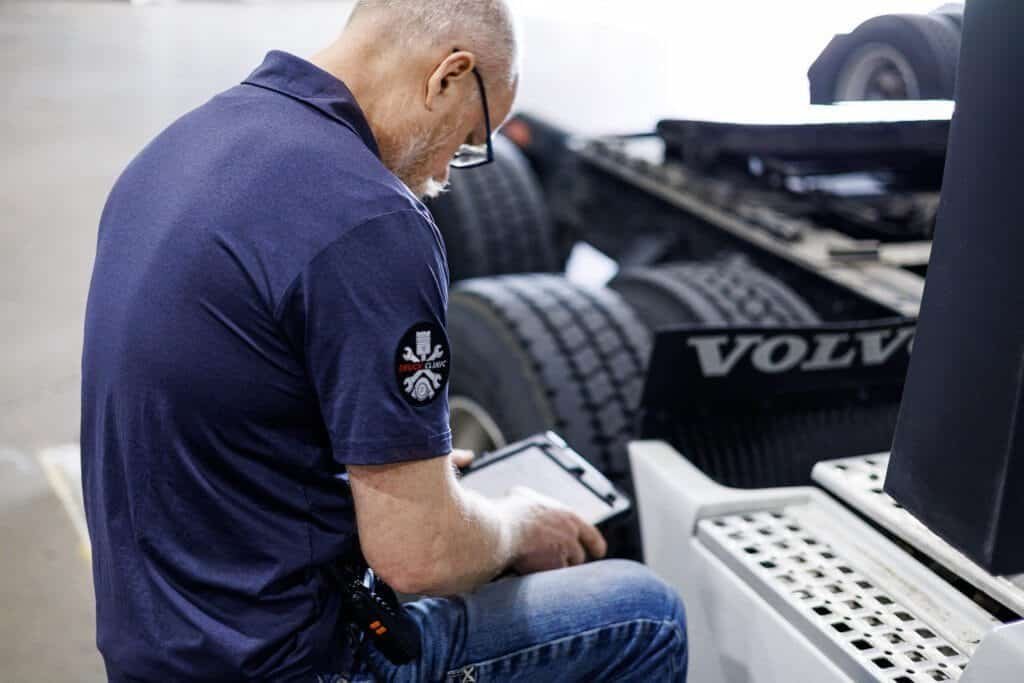

If a truck's air gauge sags overnight or the compressor never seems to shut off, an air brake leak test is the first thing to run, before anyone sprays soap or swaps parts. It needs a dash gauge, a watch and wheel chocks.
Below: how to run it, where slow leaks hide, what brake wear patterns say about the foundation brakes, and how to check slack adjuster adjustment the way an inspector on I-55 or I-80 will.
Why are my air brakes losing pressure?
Air brakes losing pressure show up three ways, and each points somewhere different.
- The gauge drops with the engine off and nobody on the pedal. Supply-side leak: tank drain cocks, dryer purge valve, governor lines, push-to-connect fittings, or an accessory such as the air seat or a suspension leveling valve.
- The gauge holds at rest but falls while the pedal is held. Service-side leak: treadle valve, relay or quick-release valves, service chamber diaphragms, or the service gladhand and trailer line.
- The compressor cycles constantly or never reaches cut-out. Either the leak exceeds the compressor's spare capacity or the compressor, unloader or governor is at fault. A compressor running past its published duty cycle is feeding a leak or wearing out.
Slow build from empty tanks usually means a worn compressor, a stuck purge valve or a restricted intake, not a leak. Moisture multiplies everything: a tired air dryer cartridge puts water in the tanks, and a Chicago winter turns that into frozen valves and brakes that will not release; the winter prep guide covers the dryer service that prevents it.
How do you do an air brake leak down test?
The air brake leak down test below follows the FMCSA model CDL manual. Chock the wheels; the parking brake has to be released for the static part.
- Build full pressure. Run the engine until the governor cuts the compressor out. The FMCSA CDL manual puts cut-out around 125 psi and cut-in around 100 psi on most trucks.
- Engine off, parking brake released, gauge settled. Time one minute. FMCSA's static limit is less than 2 psi of loss for a single vehicle and less than 3 psi for a combination.
- Full service application, held. Let the initial drop settle, then time another minute. The applied limit is less than 3 psi for a single vehicle, less than 4 psi for a combination.
- Fan the pedal down. The low-air warning must come on before the gauge falls below 60 psi, and the spring brakes should apply on their own at the manufacturer's setting, usually 20 to 45 psi.
- Record all four numbers. Static loss that creeps up month over month is a warning before the failure.
The limits are pass/fail thresholds, not a definition of healthy; any audible hiss with the engine off is a leak, and it will not shrink on its own.
Where do slow air leaks on a truck usually hide?
Once the timed test says which side leaks, isolate before you soap: disconnect the trailer and re-test, then close any isolation valves for the suspension or accessories. Then work the short list with soapy water, engine off.
Leaks that show at rest:
- Dryer purge valve. A hiss from the dryer that continues after cut-out: debris on the seat, or a failed heater letting it freeze open in January.
- Tank drain cocks and push-to-connect fittings. Corroded seats on the wet tank; nylon tubing cut at an angle or pulled sideways weeping at the collet.
- Air suspension leveling valve and air springs. A hiss at the valve or a bag flat by morning. A suspension repair item, but it drains the tanks the brakes use.
Leaks that show only on application:
- Service chamber diaphragm. Air at the chamber vent holes with the pedal down. A hiss when the parking brake is released instead is the spring-side diaphragm.
- Relay and quick-release valves. Air from the exhaust port while applied means a valve not seating, usually from wet-tank contamination.
- Gladhand seals and the trailer service line. Cracked rubber, or an emergency line never fully seated.
Repeat the test after every repair. A system that has run low usually has more than one tired seal, and the second shows once the first is fixed.
What do brake wear patterns tell you?
Brake wear patterns are a diagnostic already on the truck. Pull the wheels at a service and compare every wheel-end to its mate on the same axle.
| Wear pattern | What it usually means | What to check |
|---|---|---|
| Even, both sides of the axle close | Balanced brakes | Nothing; this is the baseline |
| One side far thinner than its mate | The thin side is doing the mate's work: the mate under-strokes, is seized or has a weak chamber | Applied stroke both sides, cam rotation, S-cam bushings, diaphragm |
| Tapered lining, thicker at one end | Worn cam bushings or anchor pins letting the shoe cock in the drum | Bushings, anchor pins, spider; new linings alone repeat the taper |
| Worn at the edges, drum bell-mouthed | Drum past its limit or overheated, so the shoe rides the lip | Drum diameter against the maximum cast into it; replace the drum |
| Glazed or heat-cracked lining, blued drum | A dragging brake: parking brake not releasing, slack too tight, air not exhausting, or a driver riding the brakes | Release at the chamber, valve exhaust, adjuster setting, driver coaching |
| Dark, oily lining | Wheel seal or hub oil soaking the lining | Replace the seal and the lining; oil-soaked material does not recover |
| Tractor linings gone, trailer barely touched | Tractor doing the trailer's work: trailer brakes out of adjustment, weak trailer relay, restricted service line | Trailer stroke at every axle, gladhand flow, trailer relay valve |
Replacing linings without fixing the pattern buys the same wear again, and most patterns trace back to adjustment or release, which is the next check. Foundation brake work, drums, cams and bushings sit under truck and trailer repair at the shop. When the leak is on the trailer, the shoes, drums, chambers, valves, gladhands and lines are handled as trailer air and brake repairs.
How do you check slack adjuster adjustment?
Slack adjuster adjustment is measured as applied pushrod stroke, and out-of-adjustment brakes are among the most common reasons a truck is put out of service at roadside. CVSA's out-of-service criteria sideline a vehicle once 20 percent or more of its service brakes are defective, and an out-of-adjustment brake counts.
- Chock the wheels and release the parking brake, with system pressure between 90 and 100 psi.
- Mark the pushrod where it leaves the chamber, brake released.
- Have a helper make a full service application and hold it. Measure from the chamber face to the mark. That is applied stroke.
- Compare it to the limit for the chamber type. Limits are set per chamber size and design in 49 CFR 393.47, and the type is stamped on the housing. At or past the limit is out of adjustment. Log every wheel-end and compare mates.
- Check the angle while applied. The arm should sit close to a right angle to the pushrod; swung well past that, it is losing force at the cam even inside the limit.
Automatic slack adjusters that keep going out of adjustment
Automatic slack adjusters take up lining wear on their own, so one that repeatedly measures long is a defect, not an adjustment job — the FMCSA CDL manual tells drivers the same. Turning the nut hides the cause for a week. The cause is usually one of these:
- Worn S-cam bushings or a bent cam tube, so the adjuster senses stroke wrong
- A seized or corroded adjuster clutch, common after a few Chicago salt seasons
- The wrong pushrod length or clevis, or an adjuster installed off its template
Manual slack adjusters, still found on older trailers, are set at the nut and then confirmed with a stroke measurement. Either way, the fix is a measurement, not a feel.
How often to measure stroke
Monthly, on every wheel-end, tractor and trailer, even with automatic adjusters; it is a few minutes per axle with a helper. Fold it into the fleet maintenance schedule and the 90-day interim check, and the annual DOT inspection, which measures the same stroke, has nothing to find. That monthly stroke check is the same one for Plainfield contractors and carriers, who send dump trucks, tractors and equipment trailers east on 135th St or IL-126.
The DOT inspection checklist shows where brakes sit in the inspector's order, and a fleet recovering a CSA score usually starts here — each out-of-adjustment brake on a roadside report adds points that outlast the repair.
Talk to Truck Clinic
If a truck in the Chicago metro is losing air or measuring long on stroke, Truck Clinic in Romeoville can run the leak test, measure every wheel-end and give you a written quote before anything is opened or ordered. Call (815) 887-0212 or request a quote; the shop is at 565 Anderson Dr Unit B, just off I-55, serving Joliet, Bolingbrook, Naperville, Plainfield and Will County, with same-day work when a bay is open.