Truck repair · Romeoville, IL
Truck and trailer DOT inspection in Romeoville, IL
Annual FMCSA inspections for trucks and trailers, with findings measured, recorded and quoted before repair.
5.0 from 203 Google reviewsWritten quote before work65+ person team
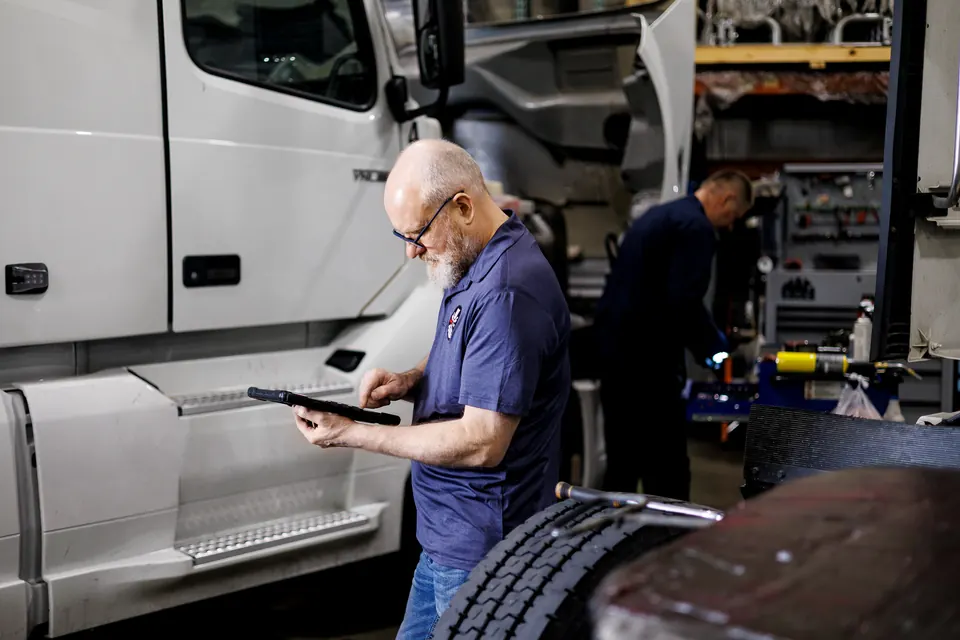
If you searched DOT inspection near me because a sticker is about to expire or a roadside stop found something, Truck Clinic does the annual periodic inspection under 49 CFR 396.17 for tractors, straight trucks and trailers — truck repair in Romeoville, IL.
The full service description
Every Appendix A item is checked and measured, the report goes on file, and any defect is quoted in writing before repair.
What's included
- Annual periodic inspection under 49 CFR 396.17
- Tractors, straight trucks and trailers, each unit on its own report
- Pushrod stroke measured at every chamber
- Air system leakdown and warning-device check
- Lighting, tires, steering, coupling and frame to Appendix A
- Report for the carrier file and decal on the unit
Prepare for your truck or trailer inspection
Let us know whether you need the truck, trailer or both inspected. Inspection time and any repair estimate depend on the equipment and findings. Contact the shop for availability before routing a unit to Romeoville; a booking does not guarantee a passing result.
What to have ready when you call
- Truck and trailer identification, including unit numbers and VINs
- Your previous inspection report and its due date
- Driver inspection reports and records of recent corrective work
- Details of any warning lights or known brake, tire or lighting defects
Visit Truck Clinic
565 Anderson Dr Unit B, Romeoville, IL 60446
In-shop service for fleets and owner-operators around Romeoville, Bolingbrook, Joliet, Lemont and the I-55 corridor.
- Monday - Friday: 7:00 AM - 5:00 PM
- Saturday: 7:00 AM - 12:00 PM
- Sunday: Closed
What does a DOT truck inspection at Truck Clinic cover?
People mean three things by DOT inspection, and only two happen at a repair shop:
Read the full section
| Who does it | What it covers | Where Truck Clinic fits | |
|---|---|---|---|
| Annual periodic inspection (396.17) | A qualified inspector at a shop or the carrier's facility | Every Appendix A system on each unit | The inspection Truck Clinic performs and documents |
| Roadside inspection (CVSA Level I, II or III) | State enforcement at scales and on the shoulder | Driver documents plus the vehicle, by level | Truck Clinic repairs what was written up and rechecks it |
| DOT physical | A medical examiner on the FMCSA registry | The driver, not the truck | Not a repair-shop service; see the DOT physical guide |
The annual DOT truck inspection follows 49 CFR 396.17 and Appendix A item by item: brakes, coupling, exhaust, fuel, lighting, securement, steering, suspension, frame, tires and wheels, windshield and wipers, rear impact guard.
Each measurement goes on the report, a copy goes to the carrier for the 14-month file 396.21 requires, and the decal goes on the unit. A trailer DOT inspection is the same procedure minus the engine items; a tractor-trailer combination is two inspections with two reports.
What do trucks usually fail on at the annual inspection?
The defects that fail an annual inspection are a short list:
Read the full section
- Brake pushrod stroke past the limit for the chamber type in 49 CFR 393.47, usually one wheel-end where an automatic slack adjuster has stopped adjusting.
- Air loss beyond the leakdown standard: a chamber diaphragm, a gladhand seal, a line chafed on a crossmember.
- Lamps out. One dead marker is a defect; a corroded seven-way plug that flickers half the trailer is an electrical repair.
- Tires below the 49 CFR 393.75 minimums, exposed cord, a sidewall bulge.
- Steering lash past the limit, a worn kingpin, fifth-wheel jaw play.
- Exhaust leaks ahead of the cab, fuel weeping at a tank fitting, frame cracks, a bent rear impact guard.
The DOT inspection checklist post covers the yard check that catches these; a defect found in the bay is written up and quoted, and the inspection is completed after the repair.
Frame, crossmember and coupling defects go to the truck and trailer repair bay before the report is signed.
How is the annual DOT inspection done, in the order the shop works?
The sequence is built so nothing is measured twice or skipped:
Read the full section
- Paperwork first. Previous report, current DVIRs and repair history, so a repeat defect is recognized.
- Cab. Horn, wipers, glazing, mirrors, seat belt, low-air warning, tractor protection valve.
- Air system. Build time, governor cut-in and cut-out, leakdown released and applied.
- Walk-around. Every lamp and reflector, fuel tank and lines, coupling, securement points, rear impact guard.
- Underneath. Pushrod stroke at every chamber on a full application, linings, drums, slack adjusters, hoses, springs, U-bolts, driveline, exhaust, frame rails.
- Steering and wheel-ends. Lash at the wheel, kingpins, tie-rod ends, hub oil, bearing play, wheel fasteners, tread.
- Report and decal. Measurements go on the report, defects are quoted in writing, and once any repair is approved and done the decal goes on.
The brake inspector has to meet 49 CFR 396.25; ask for a copy of the report before the truck leaves. Stroke or leakdown that fails is brake repair, quoted before it starts.
What drives DOT inspection cost for a truck or trailer?
No flat number here; it depends on the unit in the bay. What moves DOT inspection cost:
Read the full section
- Unit type. A trailer is brakes, air, lights, tires, suspension, frame and coupling; a tractor adds the engine-side items; a combination is two inspections.
- Condition on arrival. A clean unit is the inspection alone; defects add a quoted repair before the report can be signed.
- Brake work. The repair with the widest cost spread, from one slack adjuster to a full reline.
- Bundling and records. An inspection inside a scheduled fleet maintenance visit shares the lift time; the last report and recent DVIRs shorten the paperwork.
Any repair is quoted in writing before it starts. The inspection is cheap next to a brake out-of-service order at the scale: tow, fine and lost load.
How long does an FMCSA annual inspection take, and what slows it down?
A clean tractor or trailer is same-day when a bay is open. What stretches it:
Read the full section
- Defects that need approval. The written quote goes to the carrier and the clock pauses until it comes back.
- Parts. Brake hardware, lamps and gladhand seals are easy to source; an unusual air bag or ABS module may have to be ordered.
- Loaded trailers. They limit what can be lifted and measured; bring the trailer empty when you can.
- Shop hours. Mon–Fri 7:00 AM–5:00 PM and Saturday 7:00 AM–12:00 PM.
Booking a month ahead of the sticker date leaves room for a part to arrive.
When should you book the annual DOT inspection instead of waiting for the sticker date?
The rule is at least once every 12 months. Reasons to do it sooner:
Read the full section
- After a roadside violation. Fixing the item and running the full inspection documents the correction for the Vehicle Maintenance BASIC; the CSA score recovery guide explains the tracking.
- On a unit new to the fleet, especially a used purchase; the inspection is the cheapest way to learn the last owner's habits.
- Before a new lane. A truck that will cross into California picks up CARB requirements on top of FMCSA ones; see the CARB compliance guide.
- When a DVIR keeps repeating the same item. Three returns is a diagnosis problem, not a driver problem.
Between inspections, the items that should stop a truck are the ones in the CVSA out-of-service criteria: brake stroke past the limit, air loss, exposed cord, steering lash, a cracked frame. Anything on that list is a come-in-now item, whatever the sticker says.
Why do fleets on I-55 and I-355 do their DOT inspections in Romeoville?
For fleets in Joliet, Bolingbrook, Plainfield or Lockport searching annual DOT inspection near me, what matters is where the shop sits: just off I-55 in Will County, on the I-55 and I-355 corridor between the Joliet intermodal yards and the Chicago terminals. A unit due for inspection is dropped on the way through rather than pulled off a lane.
Read the full section
Batch units by sticker month, pair the inspection with the PM so the lift time is shared, and keep the report copies together for the 396.21 file.
What Truck Clinic does not do: mobile inspections, roadside service, pickup or delivery, or DOT physicals. The truck comes to 565 Anderson Dr Unit B in Romeoville, IL. Send the unit list and sticker dates through the contact page or call (815) 887-0212.
Free download
Print the 2-page DOT pre-inspection checklist
Every Appendix A system as a checkbox, with measurement boxes and the five defects that parked the most trucks in CVSA's 2026 Roadcheck.
Get the PDFWhy it matters
- Defects found in a bay, not at the scale house
- Measurements recorded for the 396.21 file
- Repairs quoted in writing before the report is signed
- Just off I-55 for Joliet and Bolingbrook fleets
Technical resources
- 49 CFR 396.17 periodic inspection ↗
The annual inspection rule and what Appendix A requires
- CVSA out-of-service criteria ↗
The defects that park a truck at a roadside inspection
What to expect
- 01
Book with the unit list, current sticker dates and the last inspection report
- 02
Paperwork and DVIR review before the unit goes on the lift
- 03
Cab, air system and walk-around: warning devices, leakdown, lamps, coupling
- 04
Underneath: brake stroke, linings, suspension, steering, frame, tires and wheels
- 05
Written quote for any defect; nothing repaired until you approve
- 06
Report completed, decal applied, copy provided for the carrier file
Common problems we address
One wheel-end with pushrod stroke past the limit
Almost always an automatic slack adjuster that has stopped adjusting, or a chamber that is not returning. The shop measures every chamber on a full application, fixes the cause instead of manually adjusting an automatic slack, and rechecks stroke before the report is signed.
Trailer lights that work behind one tractor and not another
A corroded seven-way plug, a bad ground at the nose box, or a chafed harness on a crossmember. Voltage-drop testing finds which one, and the repair is quoted before it is started.
No copy of last year's inspection report on file
FMCSA rule 396.21 has the carrier keep the report for 14 months, and an auditor asks for it. Truck Clinic provides a copy of each report with the measurements so the file is complete the day the truck leaves.
Your questions, answered
How often is a DOT inspection required on a truck and trailer?
At least once every 12 months for every commercial motor vehicle under 49 CFR 396.17, and each unit in a combination is inspected on its own, so a tractor and a trailer are two inspections with two reports. Many fleets do it early when a roadside violation, a new unit or a new lane makes that sensible.
How much does a DOT inspection cost?
It depends on whether the unit is a tractor, a trailer or a combination, on the condition it arrives in, and on whether a defect needs repair before the report can be finished. Brake work is the widest cost spread. Truck Clinic quotes the inspection and any repair in writing, and you decide before anything is opened.
Can a repair shop do the annual DOT inspection, or does it have to be the DOT?
The annual periodic inspection is the carrier's responsibility under 396.17 and is performed by an inspector who meets the qualifications in 396.19, not by the DOT itself; roadside inspections at the scales are the enforcement side. Truck Clinic performs the annual inspection, completes the report for the carrier's file and applies the decal.
What happens if my truck fails the DOT inspection at the shop?
The defect is measured, written up and quoted. Nothing is repaired until you approve, and once the repair is done the affected items are rechecked and the report is completed. A failed item is not left off the report to make the sticker happen.
Do you inspect trailers without the tractor?
Yes. A trailer DOT inspection is the same Appendix A procedure minus the engine items: brakes, air system, lights, tires, wheels, suspension, frame, coupling and the rear impact guard. Bring it empty where possible so it can be lifted and every position measured.
Do you do DOT physicals?
No. A DOT physical is a driver medical exam done by a medical examiner on the FMCSA National Registry, not by a repair shop. Truck Clinic inspects the vehicle; the driver's medical card comes from an examiner.
Related services
Fleet PM that keeps the annual a formality
Brakes, air, lights and tires checked every visit so the inspection finds nothing new.
Commercial truck tire service
Tread, cord and sidewall defects fixed before the inspector measures them.
Truck electrical repair
Trailer plugs, grounds and harnesses behind the lamps that fail inspections.
Also serving fleets in Aurora, Bolingbrook, Joliet, Lemont, Lockport, Naperville and Plainfield, from the one shop in Romeoville.
Further reading
From the shop's own guides.
Quote first, then the work.
Tell us what the truck is doing.
A no-start, a derate counting down, a brake out of adjustment the week before an inspection, or a fleet that needs a maintenance schedule someone actually follows — send the fault code and the engine, or call (815) 887-0212, and you get a straight answer: bay today, part first, or tow. The diagnosis and the price come to you in writing, and nothing is opened up until you approve it.
(815) 887-0212Monday - Friday: 7:00 AM - 5:00 PM
Saturday: 7:00 AM - 12:00 PM
Sunday: Closed
Shop-based only — we don't run roadside or mobile service, so the truck comes to Romeoville. Same-day whenever a bay is open.
Request a written quote
Shop-hours callback. Nothing starts until you approve the quote.