
If you have watched a truck get parked at a scale house over a brake stroke that a five-minute check would have caught, you already know why a DOT inspection checklist earns its keep. The annual scope, the roadside procedure and the out-of-service criteria are all published. Nothing an inspector finds should be news to the fleet.
Here they are in the order fleets out of Romeoville, Joliet and Bolingbrook meet them. The same checklist is what service and delivery fleets in Naperville use before the annual, and the Romeoville shop is about 20–30 minutes south of Naperville off-peak. It also covers dump trucks and equipment trailers from Plainfield, sent east on 135th St or IL-126.
Print the two-page DOT pre-inspection checklist PDF, walk it in the yard the afternoon before, and bring the unit in with the defects already written down.
What does a DOT annual inspection checklist have to cover?
Under 49 CFR 396.17, every commercial motor vehicle, including each unit in a combination, needs a periodic inspection at least once every 12 months, and the carrier is responsible for it. The report stays on file for 14 months under 396.21, and proof rides on the truck as a decal or report copy.
The scope is Appendix A to Part 396, so the DOT annual inspection checklist is that appendix:
- Brake system: service and parking brakes, drums, hoses, low-pressure warning, tractor protection valve, compressor, ABS, slack adjusters.
- Coupling devices: fifth wheel, pintle hook, drawbar, safety chains.
- Exhaust and fuel: no exhaust leak under or ahead of the cab, no fuel leak, tank secured.
- Lighting: every required lamp and reflector working.
- Safe loading: securement, and a body that will not shed parts or dunnage.
- Steering: lash at the wheel, linkage, kingpins, power steering.
- Suspension and frame: leaves, hangers, U-bolts, air bags, torque rods, rails; a cracked crossmember or rail is a truck and trailer repair job, not a brake-bay job.
- Tires, wheels and rims: tread, damage, inflation, fasteners, cracks.
- Windshield, wipers and rear impact guard: glazing, wiper function, guard present where required.
A fleet that runs fleet maintenance against this list all year turns the annual into a paperwork stop rather than a discovery.
What does a Level 1 DOT inspection include, and what is on a Level 2 or Level 3 checklist?
A Level 1 DOT inspection (CVSA writes it Level I) is the full procedure: driver documents plus the whole vehicle, including everything the inspector can reach from underneath. The other common levels are subsets.
| Level | What the inspector examines | Where the vehicle side stops |
|---|---|---|
| Level 1: North American Standard | Driver documents, then every vehicle system, underneath included | Nothing is skipped |
| Level 2: Walk-around | Driver documents plus what is visible without going under the truck | Brake stroke and underside items usually go unmeasured |
| Level 3: Driver-only | License, medical card, hours of service, seat belt, DVIR | No vehicle items at all |
A clean Level 1 earns a CVSA decal that generally keeps the unit from another full inspection while it is current.
What is on a roadside inspection checklist, in the order the inspector works?
CVSA publishes the Level 1 procedure as a 37-step sequence. Condensed into the order a driver experiences it:
- Interview and documents. Placards and the carrier name, then license, medical card, record of duty status, the last DVIR and proof of the annual inspection.
- Driver preparation. Engine off, air built, wheels chocked, parking brakes released so stroke can be measured on a full application.
- Walk-around from the front of the tractor. Headlamps, windshield and wipers, then down the left side and back up the right: fuel tank, coupling, trailer sides, rear of the trailer.
- Tires and wheel-ends at every position. Tread in the major grooves, sidewall damage, exposed cord, leaks, loose fasteners, cracked rims, hub oil on the brakes.
- Under the vehicle. Chambers, slack adjusters, pushrod stroke, hoses, drums and linings, springs, U-bolts, torque rods, driveline, exhaust, frame rails, then trailer air loss.
- Lights, emergency equipment and the report. Every lamp and signal, triangles and extinguisher, then either a decal or an out-of-service order.
The documents come first: a driver with an expired medical card or over hours is out of service before a tire is checked, so the DOT physical guide belongs in the prep.
Which out-of-service violations end the most trips?
An out-of-service order means the truck, the driver, or both stay put until the defect is fixed. The conditions come from the CVSA out-of-service criteria, and brakes have led the vehicle side in one CVSA International Roadcheck after another. What actually gets written:
- Brakes. Pushrod stroke past the limit for the chamber type, an audible leak at a chamber, a missing or broken slack adjuster, lining below minimum. Under CVSA's 20 percent rule, once a fifth of the brakes on the combination are defective the vehicle is out of service. The air brake leak test and stroke check finds these in the yard.
- Tires. Tread below the 49 CFR 393.75 minimum (4/32 inch in a major groove on the steer axle, 2/32 inch elsewhere), exposed ply, tread or sidewall separation, a flat or an audible leak. Tires that look fine from the cab still fail the gauge; tire service before the appointment costs less than the citation.
- Lighting. A dead marker lamp is a violation; no working stop lamp on the rear of the last unit is out of service at any hour, and no tail lamp is out of service whenever lights are required. Corroded pigtails and chafed harnesses cause most of these, a job for electrical repairs, not a bulb.
- Coupling. Jaws that will not close on the kingpin, a fifth wheel that moves on its mounts, cracked or missing mounting bolts, missing safety chains.
- Suspension, frame and steering. A cracked main leaf, a broken U-bolt or hanger, a cracked frame rail, steering lash over the limit, a kingpin with play.
- Fuel, exhaust and cargo. A dripping fuel leak, an exhaust leak under or ahead of the cab, too few tie-downs for the load, damaged straps or chains.
- Driver. Over hours, no record of duty status, a suspended or wrong-class license, an expired medical card, any sign of alcohol or drug use.
How do you get a truck ready for a DOT inspection the day before?
Whether the unit is due for its annual or heading up I-55 past the scale, the same yard check the afternoon before removes most of the risk. Plan on about an hour per unit with two people.
- Build air and run the leak test. Engine off, full pressure, time the drop at rest and again with the pedal held. A truck that fails either reading has a leak an inspector will hear.
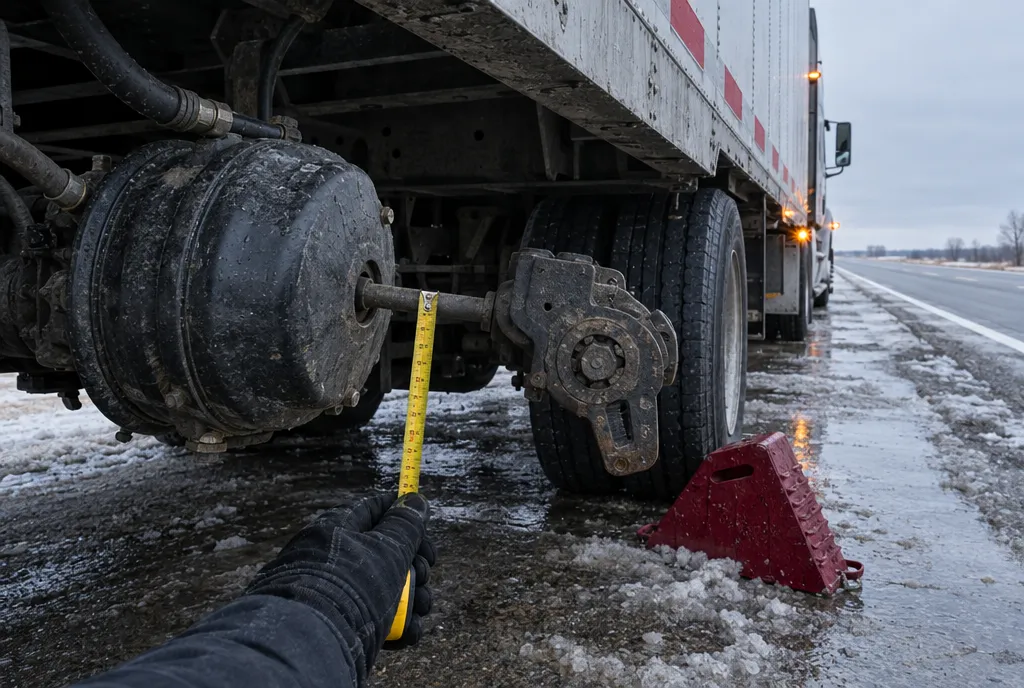
- Measure pushrod stroke at every chamber. Mark the rod at rest, make a full application, measure the travel against the limit for that chamber type. Adjust, or find out why an automatic adjuster stopped adjusting.
- Walk every lamp with a partner. Low and high beams, markers, tail, stop, turn and hazards on both units. Wiggle the trailer pigtail with the lights on; a flicker is a violation waiting for a pothole.
- Gauge the tires and check the coupling. Tread at every position, pressure against the placard, a hand along every sidewall, a look at every lug nut. Then jaws locked, no gap at the apron, chains and pigtail secure.
- Look underneath and gather the documents. Springs, hangers, U-bolts, frame rails, exhaust joints, any wet spot on a fuel line. Then license, medical card, registration, insurance, IFTA and IRP credentials, the last DVIR and the annual proof.
Anything that failed gets repaired before the appointment — not documented and hoped past. When the defect is on the trailer, such as brakes, lights or air lines, it goes to trailer repair.
Truck Clinic runs DOT inspections in the bay at 565 Anderson Dr Unit B in Romeoville, just off I-55; there is no yard visit, so the truck comes to the shop. Anything that fails comes back as a written quote, and nothing is opened or ordered until you approve it. If a bay is open, repair and reinspection can happen the same day; that depends on the schedule and on parts.
What happens after a failed roadside inspection?
The driver leaves with a Driver/Vehicle Examination Report, and an out-of-service truck does not move until the defect is repaired. Either way, 49 CFR 396.9 gives the carrier 15 days to sign the report, note the repairs and return it to the issuing agency, then keep a copy for 12 months.
The violations also land in FMCSA's Safety Measurement System for 24 months, brake and tire findings in the Vehicle Maintenance BASIC. SMS weights each violation by severity and how recent it is, so the same finding repeated across the fleet hurts more than one bad day, and the 90-day CSA recovery plan starts with exactly these reports.
Talk to Truck Clinic
If a unit is due for its annual, or the last roadside report had more lines on it than you liked, call Truck Clinic at (815) 887-0212 or request a quote and tell us which trucks and when their inspections expire. We inspect and repair in the bay at 565 Anderson Dr Unit B, Romeoville, IL 60446, for fleets running Joliet, Bolingbrook, Naperville and the I-55 / I-355 corridor.