Anyone who has waited at the scale while an inspector slid a creeper under the trailer knows the yard check is cheaper. A fail is a defect on the annual under 49 CFR 396.17, a violation written at the scale, or an out-of-service condition that parks the truck where it stands. The counts are CVSA's 2026 International Roadcheck results: 54,575 inspections, 10,350 vehicles out of service.
| # | Defect | Rule | Limit | Check | Tool |
|---|---|---|---|---|---|
| 1 | Pushrod stroke | 393.47(e) | Type 30: 2 in. (2 1/2 long-stroke) | 10 min | Chalk, tape |
| 2 | Air leak | 393.45 | No leaks; hoses secured | 5 min | Watch, soap |
| 3 | Lamp out | 393.9 | Every required lamp works | 5 min | Helper |
| 4 | Tread, cord, flat | 393.75 | 4/32 in. steer, 2/32 in. other | 10 min | Gauges |
| 5 | Cargo loose | 393.100 | No shifting or falling | 5–10 min | Hands on tie-downs |
| 6 | Lining, drum, adjuster | 393.47(d) | 1/4 in. lining, non-steer drum | 10 min | Flashlight, ruler |
| 7 | Steering lash, kingpin | 393.209 | 18 in. wheel: 2 1/4 in. manual, 4 3/4 power | 5 min | Jack, helper |
| 8 | Fifth wheel | 393.70 | Locks apply on coupling | 5 min | Flashlight, tug |
| 9 | Frame, springs, rear guard | 393.201, 393.86 | No cracked frame; guard 22 in. max | 10 min | Flashlight, tape |
1. Brake pushrod stroke past the adjustment limit
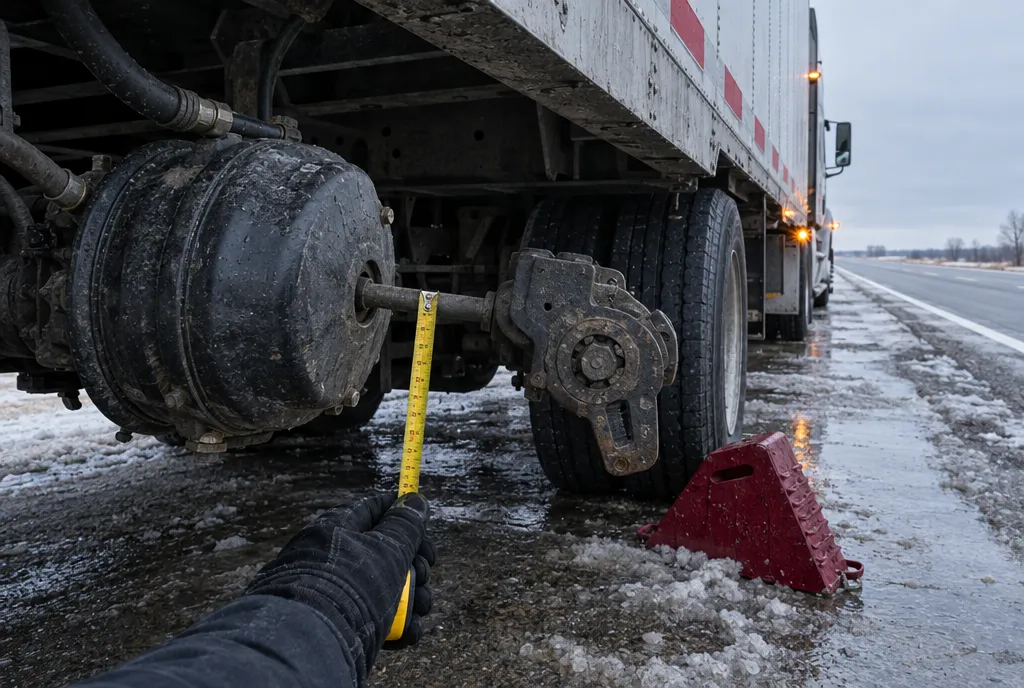
A brake out of adjustment is the single most common defect behind a failed DOT inspection. 49 CFR 393.47(e) sets the limit by chamber type: 2 inches on a standard Type 30 clamp chamber, 2 1/2 inches long-stroke, and 80 percent of rated stroke otherwise. CVSA's 20 percent rule parks the whole unit once a fifth of its brakes are out of service; 2,072 violations in 2026. Build full pressure, release the parking brakes, mark each pushrod and measure its travel on a full application, as the air brake guide shows.
2. An air leak you can hear with the engine off
An audible air leak is a violation on its own, no tool needed. 49 CFR 393.45 requires every brake connection free of leaks and every hose secured against chafing, kinking and heat. Chock the wheels, engine off, parking brakes released, then time the gauge for a minute at rest and again with the pedal held; the pass-or-fail drops are in the air brake leak test guide. Soapy water finds the hiss at a gladhand or fitting.
3. A required lamp that does not light
One dead required lamp is a violation, and lights were the fifth most common vehicle out-of-service finding in 2026, at 1,659. 49 CFR 393.9 requires every required lamp to work at all times and stay unobscured, so a mud-caked tail lamp fails like a burned-out one. Walk both units with a helper, then wiggle the trailer pigtail with the lights on; a flicker is a corroded pin or chafed harness, a job for electrical repairs.
4. Tires under tread, showing cord or losing air
Tires were the second most common out-of-service finding in 2026, at 2,914. 49 CFR 393.75 prohibits exposed ply, separation, and a flat or audibly leaking tire, and sets the minimum at 4/32 inch in a major groove on a truck or tractor's front wheels and 2/32 inch elsewhere, with cold inflation matched to the load. Gauge every position, inside duals included, feel every sidewall, and send marginal tires to tire service first.
5. Cargo that can shift, spill or fall
Cargo securement was the 2026 Roadcheck focus and the fourth most common out-of-service finding, at 1,724 violations. 49 CFR 393.100 requires cargo secured so it cannot leak, spill, blow or fall and immobilized so it cannot shift enough to affect stability or steering. Count tie-downs against the load, reject any strap with a cut, burn or fray, check every binder and anchor point, and look for dunnage that can walk out.
6. Thin lining, worn drums and a missing slack adjuster
Lining, drums and slack adjusters are the brake defects an inspector finds from the creeper. 49 CFR 393.47(d) requires at least 1/4 inch of lining at the shoe center on a non-steer air drum brake, 3/16 inch on a one-strip steer-axle shoe, and 1/8 inch on air disc pads; paragraph (g) holds drums and rotors to the manufacturer's minimum. Flashlight in every inspection hole, look for cracked lining, and feel for a bent adjuster or a missing lock.
7. Steering wheel lash and kingpin play
Steering lash and kingpin play fail quietly, because the driver steers around them. 49 CFR 393.209 sets free play at the rim by wheel diameter, 2 1/4 inches manual or 4 3/4 inches power on an 18-inch wheel, and covers the column, joints and power steering leaks. Engine running, wheels straight, turn the wheel until the tires move and mark the rim at both ends; for kingpins, jack the axle and rock the tire while a helper watches the pin.
8. Fifth-wheel jaws, mounting bolts and safety chains
A fifth wheel that is not locked ends a trip on the shoulder, not at the scale. 49 CFR 393.70 requires the lower half bolted to the frame with a device that stops it shifting, a lock that holds the kingpin until a positive manual release, and locks that apply on their own at coupling; full trailers and dollies also need safety chains as strong as the weight towed. Check the jaws closed on the kingpin, every mounting bolt present and uncracked, then tug test.
9. Frame cracks, broken springs and the rear impact guard
The underside fails on what nobody has looked at since the last annual. 49 CFR 393.201 bars a frame that is cracked, loose, sagging or broken, loose or missing body bolts, and welding or drilling on the rail flanges beyond what the manufacturer allows. 49 CFR 393.86 puts the guard on trailers of 10,000 pounds GVWR or more built since January 1998 no more than 22 inches off the ground and within 12 inches of the rear. A flashlight pass over rails, hangers, U-bolts and leaves finds most of it; suspension repair fixes it.
Which documents fail a DOT inspection before the truck is touched?
Paperwork comes first: the top driver out-of-service finding in 2026 was no medical card, at 1,072, 27 percent of driver out-of-service violations. Under 49 CFR 391.41, since June 23, 2025 a CDL or CLP holder whose medical card is current no longer carries it; the inspector pulls the status electronically, and a lapse shows there. Also ready: license, hours-of-service record, proof of the annual, registration, insurance, and the last driver vehicle inspection report if one was written, since 49 CFR 396.11 requires a report only when a defect is found.
Can you do a DOT inspection yourself?
The daily check, yes; the annual, only if you are qualified. 49 CFR 392.7 requires the driver to be satisfied that every item on its list, brakes to emergency equipment, works before the truck moves. A carrier may do its own annual under 396.17, but 49 CFR 396.19 requires whoever signs it to be qualified by a sponsored course or a year of training and experience, with the evidence on file. The printable pre-inspection checklist covers the walk-around; the signed annual is a job for a DOT inspection.
What does a defect cost when the inspector finds it first?
The same brake adjustment costs more when the inspector finds it first. At the scale it is an out-of-service order: a tow or a shoulder repair at that day's rate, a missed delivery window, and a violation that feeds the CSA score, where the 90-day recovery plan starts. Truck Clinic does not do roadside repair; the unit comes in on its wheels or on a hook, and the breakdown cost math shows what the hook adds, while the full annual checklist shows what else gets checked.
Talk to Truck Clinic
If a unit has a sticker coming due, or the last report from the scale listed anything above, book a DOT inspection in the bay at 565 Anderson Dr Unit B, Romeoville, IL 60446, just off I-55 near the Weber Rd exit, by calling (815) 887-0212 or requesting a quote. The truck comes to the shop, the defects come back as a written quote, and repair and reinspection can happen the same day when a bay is open.